
The full text from the back of Medusa's packaging:
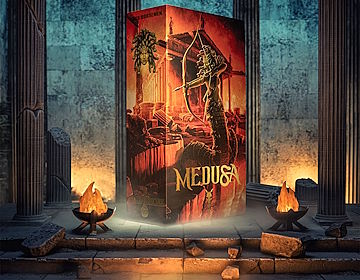
In ancient Greek mythology, the dreaded Gorgons were a trio of monstrous sisters with snakes for hair and the ability to turn any who looked upon them directly to stone. Daughters of the sea deities Phorcys and Ceto, the oldest of these sisters was Stheno the Strong while the middle child was named Euryale the Far Roaming. It was the youngest of those three sisters, and the only one who was mortal, that was the most famous, however. Her name was Medusa.
The most well-known myth associated with the Gorgon Medusa is how she was finally killed by the hero, Perseus. Tricked by his mother's would-be suitor, Poly dectes the King of Serphius, into promising him the head of Medusa as a gift, Perseus prepared to journey to the west beyond Oceanus to the edge of the known world.
There, on an island named Ssarpedon, the Gorgons lived in a dark cave whose entrance was littered with the broken statues of men who had looked upon the sisters' faces and been turned to stone. Perseus knew that the task before him would not be easy, but he was favored by the Gods and they armed him for his task.
From Hermes Perseus received a pair of winged sandals that allowed him to fly, a powerful sword, and the helmet of Hades which would turn Perseus invisible if he wore it.
From Athena her hero was gifted a brilliant bronze shield and a bag in which to carry the head of Medusa.
Coming upon the cave of the Gorgons, Perseus found the sisters sleeping. Using the reflection of the shield to find his way and avoid the gaze of the Gorgons, he cut off the head of Medusa and placed it in the bag he carried.
Donning the helmet of Hades and Hermes' sandals, the invisible Perseus escaped into the sky while Medusa's sisters chased after her killer, growing enraged when they could not find him.
Escaping from Sarpedon, Perseus went on to other adventures and exploits, eventually presenting the Goddess Athena with the head of Medusa. Athena placed it upon her shield, the Aegis.
In an interesting twist to this story, the monstrous Medusa's visage eventually became a symbol of protection. The name "Medusa" translates to "guardian" or "protectress" and her symbol was used by Greek soldiers on shields to offer protection in battle and placed upon buildings to ward off evil and misfortune.
In our modern world, the likeness of Medusa is often used to symbolize feminine power and the overcoming of trauma, for not even death could diminish the power of the Gorgon.
In the included booklet (and on the website, there's an author's note about how there are many different versions of the Medusa myth, which is really just a polite way of saying "we're not mentioning the version where she was raped by Poseidon because that would be uncomfortable to include."

