Points of Articulation
The Toy Glossary
I thought it might be handy to create a gloassary of often-used terms from the toy world. This way if there's a strange term in one of our reviews, you can look it up here. We're constantly updating this list and accepting suggestions, as well.
This list has appeared, in various forms, on several sites over the years. It's still helpful, though, and will instruct you in the ways of the world.
Or at least in the ways of the toy world.
- ABS
- Acrylonitrile butadiene styrene. One of the two most common plastics used in the manufacture of action figures. ABS plastic is generally harder and more brittle than PVC.
- Accessories
- The various accoutrements that come packaged with, and are intended for use by, an action figure. Superman's cape is an accessory; a Star Wars Freeze Frame slide is not.
- Accessory Pack
- A set of accessories, typicaly intended for a specific line of figures, that come packed by themselves instead of with an individual figure. Can be either reissues of old accessories or entirely new offerings.
- Army-builder
- Any figure in a line standard enough in appearance to create an army of characters by buying multiple copies of the toy. Star Wars Stormtroopers, Lord of the Rings Easterlings and Plan B SWAT Officers are examples. Also called a troop-builder.
- Articulation
- Movement in a figure. Typically found in places like the neck, waist, and other major joints. However, can sometimes be found in other areas, such as mid-bicep or thigh.
- BAF
- Build-A-Figure. A single character, packed in pieces as accessories with the other figures in a series. Though the idea gained popularity with ToyBiz's Marvel Legends, the first North American example was in McFarlane Toys' Metal Gear Solid 2 line. Also known as a "big-ass figure."
- Balljoint
- A type of joint that allows for a wide range of motion, usually in a shoulder or hip. There are two main types of balljoints: 1) a hinge/pin joint combined with a swivel/peg joint and 2) a true ball and socket joint. Type 1 is much more common.
- The Big Five
- 1) The main points of articulation shared by almost all action figures - neck, shoulders, and hips.
2) The five national retail stores that sell toys: KB Toys, Kmart, Target, Toys R Us and Wal*Mart. see also: Market Six, Specialty Market
- Blind Box
- also Blind Pack. A style of packaging that does not allow the purchaser to see the figure inside. Often used to sell randomly packed figures such as Kubricks.
- Blister Pack
- also Blister Card. The typical fashion of packaging an action figure, features a plastic bubble glued to a cardboard backing.
- Chase
- Any rare or shortpacked figure in a particular series. It could be a variant, or could just be the figure that everyone wants. So named because collectors "chase" after it.
- Clamshell
- Packaging that is more "collector friendly," meaning that it is resistant to dents and bending, but also indescribably hard to open.
- Collector
- Someone who buys toys because they enjoy them, whether loose or mint.
- Custom
- An action figure that has been changed by the consumer in some way from its mass market counterparts, either to improve the existing figure or make another character all together.
- Doop stand
- The clear, three-section display stand included with many Marvel Legends figures. Named after the first figure to use it, ML6's Doop.
- Exclusive
- A figure, variant, or set sold through ony one store or a limited number of specific stores. The Ash and Pit Witch set from the Movie Maniacs line was exclusive to the Sam Goody/Suncoast/Musicland/Media Play/On Cue family of stores.
- Flocking
- A production method which can be used to give toys hair or fur. A full explanation can be found here.
- Heavypack
- The opposite of a shortpack - the figure that has more per case than the rest of its fellows.
- Hoarder
- Someone who buys toys with an intent to resell. Will buy as many of a single figure as they can find, squirrelling them away in the hopes that their value will increase. This buying practice can create a local shortage, and therefore the desired price increase. Most damaging to the collector market in the long term.
- J-card
- A blister pack with a j-shaped notch in the top, designed to hang on a peg for display. The j-shaped notch allows figures from the back of the peg to be removed without removing all the figures in front.
- Joint
- Where a figure moves. There are several kinds of joints, including Peg, Pin and Ball.
- Kayfabe
- The portrayal of fictional events as real. Presenting "in-story" reasons for conditions and events as true.
- Licensed Property
- A line of toys based on an outside source. Toys based on tv, comics and movies are licensed properties. Retail stores are more likely to support a licensed property, because the show or movie acts as free advertising for the toys.
- Line
- An entire family of action figures, encompasing both Series and Waves. All Spawn figures are one line.
- Market Six
- The sixth retail outlet (after the Big Five). This is a collective term for stores outside the standard distribution channels: drug stores, department stores, supermarkets, etc.
- Mint
- Perfect. A figure that has never been damaged in any way. Used most often in sales descriptions such as MOC (mint on card).
- NECA Arm
- A swivel elbow joint that is at a nearly 90° angle to the arm, thereby adding almost no playability to the figure. A swivel joint at a 45° angle allows the limb to be posed in straight or bent positions, while one at 90° only allows the arm to spin.
- Original Property
- A line of toys and characters developed in-house, with no pre-existing outside support. Examples include Lego's Bionicle and Mezco's Tikimon. Despite being created by McFarlane Toys, the Spawn line is not an original property.
- Party _______
- A figure wearing a skirt or other similar clothes, but without painted underwear. The term comes from the orginal McFarlane Toys release of Angela, who was wearing a loincloth but was missing the white paint app intended for her crotch, leaving it the flesh-toned color of the plastic. Fans dubbed the figure "Party Angela."
- Peg Joint
- The traditional joint found at the neck or waist. A peg on one part of the figure (the head, for instance) is inserted into the hollow main body cavity. The head and body are then flush against each other, and remain that way. This allows for 360° of motion. Sometimes called a "swivel" or "cut" joint.
- Pegwarmer
- A figure that doesn't sell as well as thought, was therefore over-ordered, and is now hanging dusty in some discount aisle.
- Pin Joint
- A joint normally found in elbows and knees. Works like a hinge; a pin is inserted sideways at the elbow (in this example), joining the upper and lower arm and usually allowing for a 90° range of motion. Pin joints are typically the most obvious style of joint.
- PVC
- Polyvinylchloride. One of the two most common plastics used in the manufacture of action figures. PVC plastic can be made more soft and flexible than ABS plastic, and is usually used for capes and other rubbery items - PVC is a thermoplastic, which means it softens as it is warmed and hardens as it cools.
- Redeco
- More involved than a simple repaint, something other than the paint scheme is adjusted. Vampire Angel from Buffy Series I is a redeco, having a new head and hands.
- Reissue
- A rerelease of a figure or accessory. Can be as part of a set or alone, repainted or not. Typically has some feature to set it apart from the original figures. The '80s Masters of the Universe line was rereleased with new collector's packaging, but no other changes.
- Repaint
- Just what it sounds like. A figure that has been painted in new colors, whether as a production change or to create a new figure.
- Rotocast
- A production method which creates large hollow pieces. A full explanation can be found here.
- Scalper
- Someone who buys figures specifically to resell. Seeks out the rarest or most popular figures, then sells them soon after at a large markup. Most damaging the collector's market in the short-term.
- Series
- A specific subsection of a line of figures. Spawn: the Samurai Wars was Series 19 in the Spawn line. A Series can have any number of waves.
- Shortpack
- The figure in a case that is included in lower supply than its fellows - often the female toys, or the villains.
- Specialty Stores
- Small stores that seldom carry the same toys as mass-market outlets, focusing instead on limited-run and import figures. Comicshops, Suncoast, Tower Records, Spencer's and Hot Topic are all specialty shops.
- Springfield Four
- The limited articulation found on every World of Springfield figure: neck, shoulders and waist.
- Toyetic
- A marketing term that describes how easy/likely it would be to turn something from a property into a successful toy. It is often the reason that characters in a cartoon will wear special costumes, like Deep Space Superman, or ride on special vehicles, like the TMNT Sewer Slider motorcycle.
- Vac-metallized
- Sometimes referred to as "chromed." A shiny, metallic piece of plastic, often armor or a weapon. An explanation of the vac-metallizing process can be found here.
- Variant
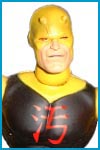
- A slightly different version of a figure, typically found in smaller numbers than its standard counterpart. Can either be due to a change in production, such as the three Jean Grey figures from the X-Men movie line, or a specific choice on the part of the manufacturer, such as the yellow and brown Daredevil from Spider-Man Classics Series II.
- Vanilla
- The plain, unadorned version of a character. No action features, no special costumes, just the standard version of the charatcer in question.
- Wave
- A specific shipment within a series of figures. Wave 1 is the first batch of figures sent out from the factory. Subsequent waves may have production changes, thereby creating variants.
- YDD Syndrome
- The artificially inflated desire for an otherwise unpopular figure created by shortpacking. Named for the scalping frenzy seen in the wake of the Yellow Daredevil figure from ToyBiz's Spider-Man Classics Series II.
|